
Residential Air Purifiers Market Size by Segments, Country, Region – Revenue Pool Analysis, Margin Structure Assessment, Capital Flow Trends, Competitive Benchmarking & Forecast to 2032
Overview
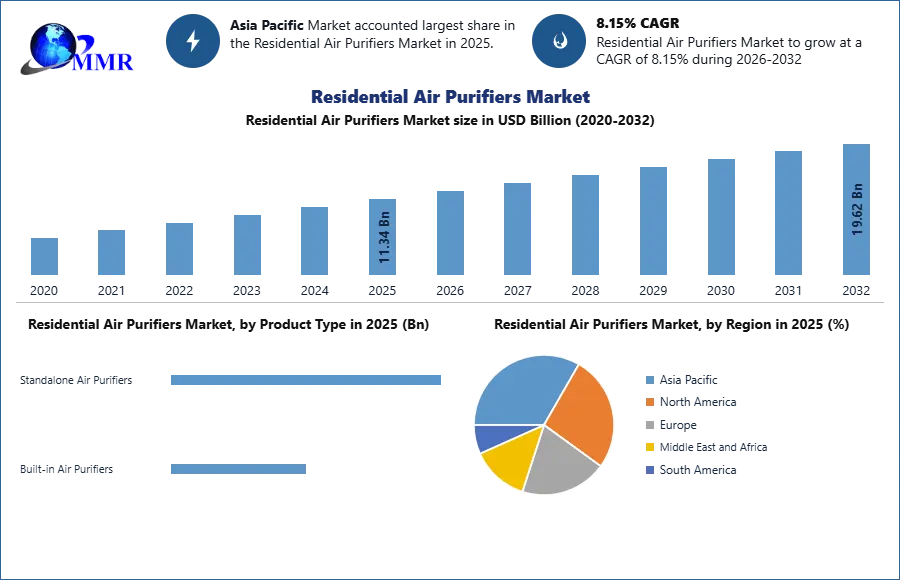
The Residential Air Purifiers Market size was valued at USD 11.34 Bn. in 2025 and the total Insulation revenue is expected to grow by 8.15% from 2026 to 2032, reaching nearly USD 19.62 Bn. by 2032
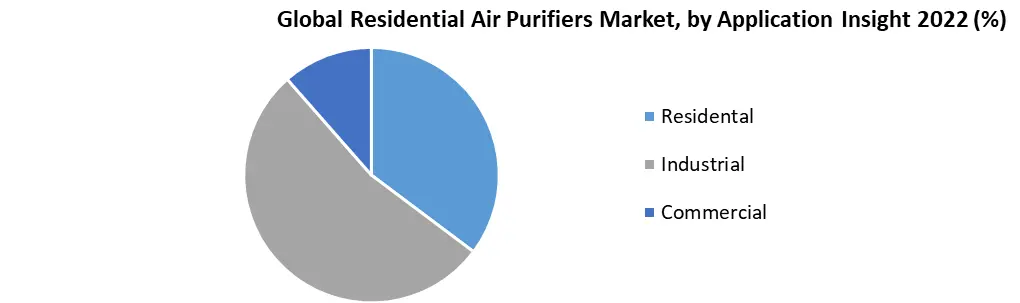
Residential air purifiers and air cleaners are machines that remove airborne contaminants including dust, smoke, pollen, and pet dander to enhance the quality of the air indoors. The primary part of a home air purifier is the high-efficiency air filter. Residential air purifiers come in two primary categories: stand-alone and in-duct. Stand-alone, as the name implies, is a portable room system made to purify and cleanse the air in a specific room at home or work.
The majority of the materials used to construct stand-alone air purifier cases are plastic, typically high-impact polystyrene, polyvinyl chloride, high-density polyethylene, or polypropylene. On the other hand, an in-duct air purifier system filters all the air passing in the house while working with the furnace and central air conditioning.
Scope of the Report:
This study aids in understanding the industry and then making strategies for the business growth accordingly. In the strategy analysis it offers insights from marketing channels and the industry positioning to the potential power growth strategies offering in-depth analysis for the new participants or existing key players in the Residential air purifiers market. The Research aims to provide users with an detailed analysis of the Residential Air Purifiers Market.
The study looks at the markets recent, ongoing, and future changes. It also provides a simple analysis of complex data. New entrants, industry titans, and followers are some of the primary forces that actively and carefully perform research. The study displays the results of the PORTER and PESTEL analyses as well as probable outcomes of the microeconomic market elements. After accounting for internal and external variables that can have a favorable or unfavorable impact on the firm, decision-makers will have a clear futuristic perspective of the market.
The market segmentation analysis and market size forecast in the research help investors better understand the dynamics and structure of the Residential air purifiers market. The report acts as a buyer's guide by clearly outlining the comparative analysis of the top Residential air purifiers businesses by price, financial position, product, product portfolio, growth strategies, and regional presence.
To know about the Research Methodology :- Request Free Sample Report
Residential Air Purifiers Market Dynamics:
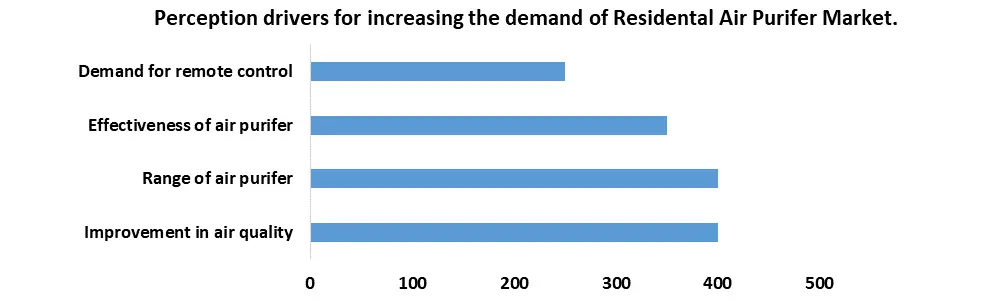
The Residential Air Purifiers Market is being propelled by increasing consumer awareness of indoor air quality and health impacts, particularly in urban environments where pollution, allergens, and airborne pathogens are prevalent. As homeowners become more conscious of respiratory health, demand for air purification solutions has strengthened considerably. The market is also supported by technological advancements such as the integration of HEPA filters, activated carbon filtration, UV light sterilization, and smart connectivity (IoT and app controls), which enhance performance and user convenience. In addition, rising concerns over airborne viruses and seasonal allergens have further amplified adoption, encouraging consumers to invest in more effective air purifiers for living spaces, bedrooms, and home offices.
In addition to health awareness, regulatory standards and environmental policies in key regions like North America and Europe are influencing market growth by encouraging cleaner indoor environments and promoting energy‑efficient products. Manufacturers are responding by developing energy‑efficient, low‑noise, and eco‑friendly models to meet regulatory requirements and consumer expectations. The expansion of online retail channels has also made residential air purifiers more accessible, contributing to broader market penetration across demographics. While affordability remains a concern in emerging regions, ongoing price optimization and product diversification—from premium smart units to cost‑effective portable models—are helping to sustain demand. Collectively, these factors are shaping a competitive market landscape characterized by continuous innovation, expanded product portfolios, and increasing global uptake of residential air purification systems.
Limitation Of Air Purifers
The filters used in the Residental Air Purifiers, don’t last forever. Depending on the usage, the filter are mandatory to change every six months. Morever the majority of standalone or portable air purifiers can only monitor a small area's air quality, and they lack the ability to acquire three-dimensional data. Instead of using active monitoring sensor nodes, many air quality monitoring systems use passive monitoring sensor nodes, which necessitate human data update on a regular basis. Active monitoring sensor nodes have the ability to automatically collect, send, and store data across wireless or other networks. Lack of active monitoring sensor nodes can lead to technical restrictions with particular air purifiers, which negatively affect the adoption and perhaps restrain the Residental Air Purifer market's growth.
Emerging Technologies and Startups
The US based startup Molekule has developed PECO (Petroelectrochemical oxidation) which addresses air contamination issues by oxidizing and removing organic particles, especially indoor allergens purifiers.These new revolutionary technology has provided a exclusive purification solution, moreover this PECO air purification technology has contributed a great opportunity in Resdiental Air Purifer market. Manufacturers and distributors of household air purifiers have plenty of chances in the upcoming years thanks to emerging countries like China, India, Brazil, and Russia. This can be attributed to the rising levels of air pollution in these nations, as well as rising public awareness, an increase in the number of diseases brought on by air pollution, increased consumer spending due to population growth and rising disposable incomes, and increased government spending for efficient air quality monitoring are creating the growth opportunity for the Residental Air Purifier Market.
Residential Air Purifiers Market Segment Analysis:
By Technology Insights, In 2025, HEPA was the market leader and was responsible for over 41.1% of global sales. Pollen, dust, smoke, and bio-contaminants are just a few of the airborne particles that HEPA filters are very effective at capturing. HEPA filters' superior performance and dependability in removing airborne particles will probably help them gain traction on the world market. Small bits of carbon in the form of powdered blocks or granules that have been properly treated with oxygen to open the pores of the carbon atoms make up activated carbon or activated charcoal filters.
The ionic filters segment is anticipated to grow at a CAGR of 6.8%. Since ionic filters do not need to be changed frequently, their market share is growing. However, the production of ionised air and ozone during the purification process is to blame for the development of respiratory conditions like asthma, which is likely to restrict the use of the technology. Ozone generation, photocatalytic oxidation, UV radiation, non-thermal plasma, and electrostatic precipitators are further air purification techniques. With the use of photocatalytic oxidation, harmful gases and tiny particles as small as 0.1 micron can be changed into harmless substances.
Residential Air Purifiers Market Regional Insights:
In 2025, the Asia‑Pacific region is the largest market for residential air purifiers, driven by severe outdoor and indoor air pollution in major economies such as China, India, Japan, and South Korea. Rapid urbanization, high population density, and increasing awareness of indoor air quality have translated into strong demand for air purification solutions in households across Asia Pacific. China alone accounted for a substantial share of global residential air purifier sales, reflecting the urgency among consumers to mitigate the health impacts of particulate matter (PM2.5) and other pollutants. The wide availability of products, from high‑end smart devices to affordable portable units, has further strengthened regional adoption. Technological innovation and growing disposable incomes also support the strong performance of this region in 2025.
North America and Europe follow as key regional markets in 2025, with steady growth driven by stringent environmental regulations, heightened health consciousness, and increased consumer spending on home wellness products. In North America, especially in the United States and Canada, air purifiers are widely adopted due to concerns over indoor allergens, wildfire smoke, and respiratory health awareness. Europe’s market benefits from strict indoor air quality standards and strong demand for energy‑efficient, low‑noise devices.
Residential Air Purifiers Market Recent Developments
| Exact Date | Company | Development | Impact |
|---|---|---|---|
| 18 March 2026 | Dyson | The Dyson HushJet™ Purifier Compact was awarded "Best Air Purifier 2025" at the DeviceNext Tech Awards, recognized for its redesigned nozzle and ultra-quiet airflow system. | The award validates Dyson's shift toward compact, noise-optimized designs specifically targeting bedrooms and small urban living spaces. |
| 22 January 2026 | Daikin Industries Ltd. | Daikin was selected for the "Clarivate Top 100 Global Innovators 2026", highlighting its R&D leadership in Streamer technology and indoor air quality (IAQ) solutions. | Continued innovation in patented decomposition technologies strengthens Daikin's premium market position against competitors relying solely on passive HEPA filtration. |
| 05 January 2026 | Coway Co. Ltd. | Coway was named a CES 2026 Innovation Awards Honoree for its "Smart Self-cleaning Air Purifier," featuring automated filter maintenance. | This development addresses the primary consumer pain point of recurring maintenance, potentially extending filter life and improving long-term device efficiency. |
| 30 December 2025 | Xiaomi Corporation | Xiaomi launched the Mijia Air Purifier 6 Pro, featuring a dual-core architecture that separates daily purification from deep formaldehyde removal. | By doubling formaldehyde removal effectiveness, Xiaomi is aggressively targeting the post-renovation market segment and homes with new furniture. |
| 03 December 2025 | Dyson | Dyson expanded its HushJet™ series globally, replacing the traditional loop design with a concentrated entrainment nozzle to reduce turbulence. | The new engineering achieves 24 dBA operation in sleep mode, setting a new industry benchmark for quiet, whole-room air circulation. |
| 12 February 2025 | Camfil AB | Camfil introduced the Opakfil ES+, an advanced small V-Bank filter designed for higher performance and lower environmental impact. | The filter's longer service life reduces the total cost of ownership, appealing to sustainability-conscious consumers and commercial-residential mixed-use facilities. |
Residential Air Purifiers Market Scope: Inquire before buying
| Residential Air Purifiers Market | |||
|---|---|---|---|
| Report Coverage | Details | ||
| Base Year: | 2025 | Forecast Period: | 2026-2032 |
| Historical Data: | 2020 to 2025 | Market Size in 2025: | 11.34 USD Billion |
| Forecast Period 2026-2032 CAGR: | 8.15% | Market Size in 2032: | 19.62 USD Billion |
| Segments Covered: | by Product Type | Standalone Air Purifiers Built‑in Air Purifiers |
|
| by Technology | HEPA (High‑Efficiency Particulate Air) Activated Carbon Ionic/ Electrostatic UV (Ultraviolet) Ozone Technology Other |
||
| by Filter Type | HEPA Filter Activated Carbon Filter Pre‑Filter UV Lamp Other |
||
| by Distribution Channel | Online Retail Offline Retail |
||
Residential Air Purifiers Market, by Region
North America (United States, Canada and Mexico)
Europe (UK, France, Germany, Italy, Spain, Sweden, Austria, Turkey, Russia and Rest of Europe)
Asia Pacific (China, India, Japan, South Korea, Australia, ASEAN and Rest of APAC)
Middle East and Africa (South Africa, GCC, Egypt, Nigeria and Rest of ME&A)
South America (Brazil, Argentina, Columbia and Rest of South America)
Residential Air Purifiers Market Key Players are:
- Daikin Industries Ltd.
- Sharp Corporation
- Panasonic Corporation
- Honeywell International Inc.
- Whirlpool Corporation
- Dyson
- Alen Corporation
- Airgle Corporation
- Hunter Pure Air
- Samsung Electronics Co. Ltd.
- WINIX Co. Ltd.
- LG Electronics Inc.
- Koninklijke Philips N.V.
- Unilever Group
- AllerAir Industries Inc.
- IQAir
- Xiaomi Corporation
- Camfil AB
- Kent RO Systems Ltd.
- HSIL Limited
- Coway Co. Ltd.
- Austin Air Systems Ltd
- Levoit (Vesync Co. Ltd)
- Molekule Group Inc.
- Blueair
Others